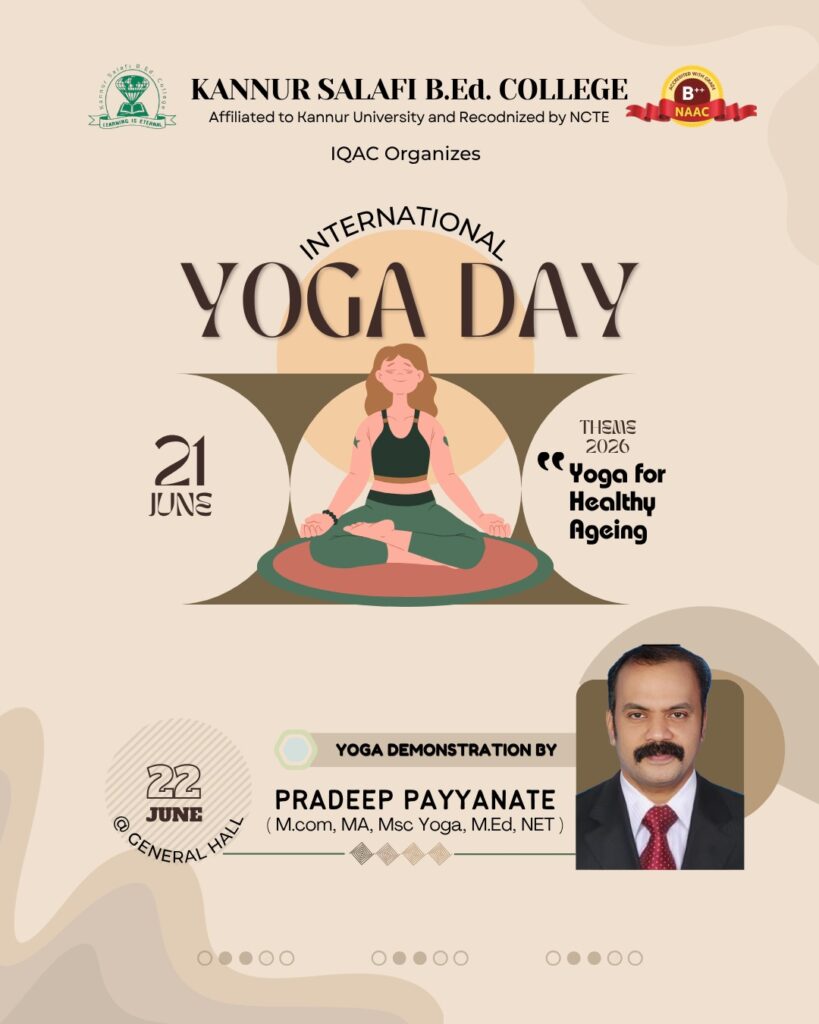
As part of the observance of the 12th International Yoga Day, the IQAC of Kannur Salafi
B.Ed. College organized a Yoga Demonstration Session on 22 June 2026 at the General
Hall. The programme was led by Mr. Pradeep Payyanatem (M.Com., MA, MSc Yoga, M.Ed.,
NET), an experienced yoga instructor and practitioner. The session aimed to create
awareness about the significance of yoga in maintaining physical, mental, and emotional
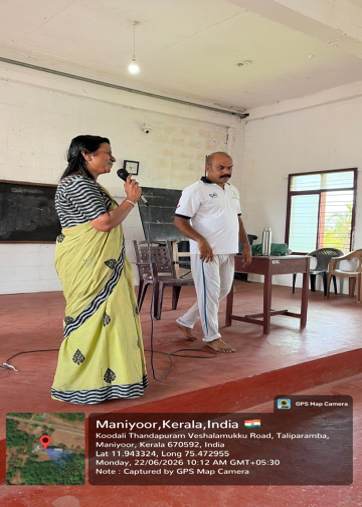
well-being. The programme commenced with an informative talk by the resource person on the
importance of International Yoga Day and the role of yoga in promoting a healthy lifestyle.
He explained how the regular practice of yoga helps in delaying the onset of lifestyle
diseases, improving immunity, reducing stress, and enhancing overall quality of life.
Emphasizing the theme “Yoga for Healthy Ageing,” he highlighted yoga as a holistic
approach to maintaining health and vitality throughout different stages of life.
The practical session began with a series of warm-up exercises designed to prepare the
body for yoga practice. Participants performed joint rotations, stretching exercises, and spot
jogging. During this phase, the instructor encouraged students to observe physiological
changes such as increased respiration rate, enhanced blood circulation, and muscle
activation, thereby helping them understand the body’s response to physical activity.
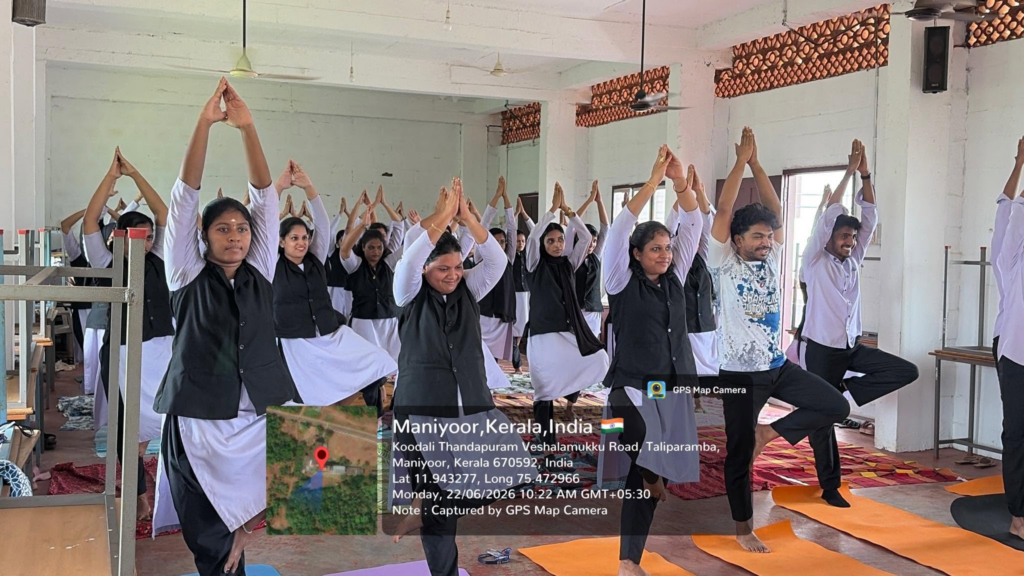
Following the warm-up, the instructor introduced a few standing postures. One of the major
asanas demonstrated was Vrikshasana (Tree Pose), in which participants balanced on one
leg while stretching both arms upward with palms joined above the head. The posture was
explained as an effective means of improving balance, concentration, and neuromuscular
coordination.
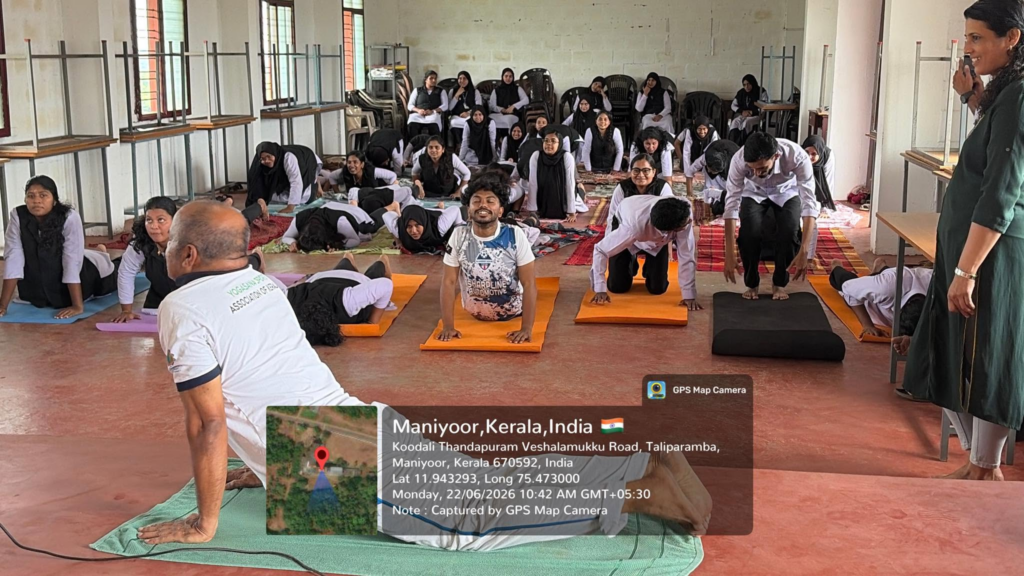
The session then progressed to seated postures. Participants practised Vajrasana
(Thunderbolt Pose), a meditative posture known for aiding digestion and promoting
mindfulness. Another seated posture demonstrated was Paschimottanasana (Seated
Forward Bend), where learners stretched forward to hold their feet while attempting to bring
the nose towards the knees. The instructor explained its benefits for spinal flexibility and
relaxation.The next segment involved supine and prone postures. While lying on the back, participants performed Uttanapadasana (Raised Leg Pose) by lifting one leg to approximately a 45-degree angle. Subsequently, while lying face down, they practised Bhujangasana (Cobra
Pose) by placing the palms at shoulder level and lifting the chest and head upward. This
was followed by Dhanurasana (Bow Pose), where participants bent their knees, held their
ankles with their hands, and attempted to lift both the chest and legs off the floor. The
instructor elaborated on the therapeutic benefits of these postures for spinal health,
flexibility, and respiratory efficiency.
After completing these asanas, participants were guided into a relaxation posture. They lay
comfortably on their backs with their eyes closed and palms facing upward. The instructor
emphasized conscious relaxation and body awareness. Participants were then instructed to
turn gently to the right side and rise slowly with the support of the left hand, ensuring a
smooth transition from the relaxation phase.A major highlight of the session was the demonstration of Surya Namaskara (SunSalutation). The resource person explained its significance as a comprehensive sequenceintegrating stretching, strengthening, breathing, and concentration. He remarked thatpractising Surya Namaskara ten times daily at a brisk pace can provide substantial physicalbenefits and serve as an effective alternative to many conventional fitness routines. He
demonstrated the complete sequence and guided the participants through its practice.
Before concluding with Shavasana (Corpse Pose), the instructor introduced the concept of
Pranayama, emphasizing the importance of breath regulation in yoga. Alongside practical
demonstrations, he explained the philosophical foundation of yoga through Ashtanga Yoga,
the eightfold path described by Sage Patanjali:
- Yama – Ethical restraints and moral disciplines.
- Niyama – Personal observances and self-discipline.
- Asana – Physical postures promoting stability and health.
- Pranayama – Regulation and control of breath.
- Pratyahara – Withdrawal of the senses from external distractions.
- Dharana – Concentration and focused attention.
- Dhyana – Meditation and uninterrupted awareness.
- Samadhi – A state of spiritual absorption and self-realization.
The instructor explained how these eight limbs collectively contribute to physical health,
mental clarity, emotional balance, and spiritual growth. He also noted that certain yogic
breathing techniques are particularly beneficial for individuals suffering from allergies and
respiratory ailments.As part of the discussion on yogic cleansing techniques (Shatkarmas), he introduced JalaNeti, a traditional nasal cleansing practice. The method involves passing lukewarm salinewater through one nostril and allowing it to flow out through the other. He explained that the
salinity and temperature of the water should be similar to that of natural tears. According to
the instructor, regular practice of Jala Neti can help relieve nasal congestion, sinus-related
discomfort, allergic conditions, and other respiratory issues.
The session continued with Shavasana, allowing participants to experience deep relaxation
and mental calmness after the physically engaging activities. The programme proved to be
both informative and experiential, providing students with valuable insights into the scientific,
therapeutic, and philosophical dimensions of yoga. The active participation and enthusiasm
displayed by the students reflected the success of the programme in promoting awareness
about the importance of yoga in daily life and healthy ageing.
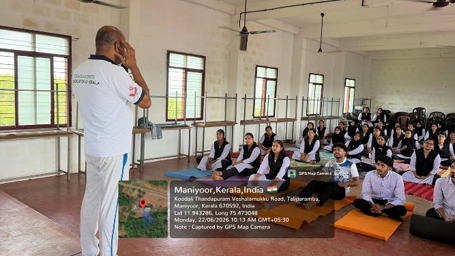
A yoga session was conducted with the objective of promoting physical health, mental well-being, concentration, and relaxation among the students. The session began with a brief introduction to yoga, highlighting its significance as one of India’s greatest contributions to the world. Students were informed that the word “Yoga” is derived from the Sanskrit root Yuj, which means “to unite” or “to join,” referring to the union of the body, mind, and spirit. The contribution of Sage Patanjali to the systematization of yoga through the Yoga Sutras was also discussed. The famous sutra “Yoga Chitta Vritti Nirodhah” was explained as the control of the fluctuations of the mind. The different states of the mind according to yoga, namely Kshipta, Vikshipta, Mudha, Ekagra, and Niruddha, were also introduced, emphasizing that the ultimate aim of yoga is to attain a calm and controlled state of mind. The practical session commenced with basic pranayama exercises. Students were instructed to sit comfortably and practice controlled breathing by inhaling deeply through the nose, holding the breath for a few seconds, and exhaling slowly and completely. This exercise was repeated several times to improve concentration and induce relaxation. After completing Surya Namaskara, students practiced Nadi Shodhana Pranayama, also known as Alternate Nostril Breathing. They inhaled through one nostril while closing the other, briefly retained the breath, and then exhaled through the opposite nostril. The cycle was repeated several times. This practice helped improve breathing efficiency, enhance concentration, and create a sense of mental calmness. The next stage of the session focused on Pratyahara, the withdrawal of the senses from external distractions. Students were guided to shift their attention away from surrounding sights and sounds and direct their awareness inward. They concentrated on their breathing and inner experiences, which helped prepare their minds for deeper levels of concentration. Following this, students practiced Dharana, or concentration, by focusing their attention on a single point, particularly their breath. They were encouraged to avoid distractions and maintain steady awareness, thereby strengthening their mental focus and concentration. The session then moved on to meditation through Shavasana. Students lay comfortably on their backs with their arms resting beside the body and their eyes gently closed. They practiced slow and deep breathing while being guided through a systematic relaxation process. Attention was gradually directed to different parts of the body, beginning with the feet and legs and moving upward to the abdomen, chest, shoulders, arms, neck, and face. Students were encouraged to relax each body part completely and observe their natural breathing. They also became aware of external and internal sounds without reacting to them. This practice promoted deep physical and mental relaxation and helped students experience a sense of inner peace. After the relaxation phase, students were gently guided back to an active state. They slowly turned to the right side, used the support of the left hand, and gradually sat up while maintaining an erect posture. A facial relaxation exercise was then conducted. Students closed their ears with their thumbs, placed their fingers gently over different parts of the face, and remained in this position for a short period while breathing normally. They then rubbed their palms together to generate warmth and gently placed them over their face and eyes. This exercise relaxed the facial muscles and refreshed the senses. The session concluded with Bhramari Pranayama, also known as Bee Breathing. Students sat comfortably with their backs straight and eyes closed. After taking a deep breath through the nose, they exhaled slowly while producing a soft humming sound resembling the buzzing of a bee. They focused on the vibrations created by the sound and repeated the practice several times. This exercise helped reduce stress and anxiety, improve concentration, calm the nervous system, and promote mental relaxation. Overall, the yoga session was highly beneficial and provided students with an opportunity to improve their physical health, mental strength, emotional balance, and concentration. Through breathing exercises, sensory withdrawal, concentration practices, meditation, and relaxation techniques, students experienced a sense of calmness and well-being. The session concluded with a reminder that regular yoga practice contributes to a healthy body, a peaceful mind, and a balanced life.
The Yoga Day session concluded with a vote of thanks delivered by Mr. Pradeep Sir to Mr. Sachin Eliyas, our Physical Education Teacher for his detailed explanation and practical demonstration. Mr. Pradeep also highlighted the future benefits and scope of yoga in schools and colleges. The session was very useful and informative.